

Village Dissolution in New York: History, Law, and Local Choice
New York’s village dissolutions are not a new phenomenon, nor is it a modern political experiment. It is the product of more than a century of local government evolution, shaped by population shifts, changing economies, and growing recognition that municipal structures must adapt when communities do.

Early dissolutions: community life changes faster than municipal boundaries
At the start of the 1900s, villages were often created to provide services that towns either couldn’t or didn’t, such as street lighting, sidewalks, policing, or water. But as transportation improved and settlement patterns shifted, some small villages found themselves with shrinking populations, limited tax base growth, or reduced need for a separate corporate structure.
Dissolutions appeared sporadically across the first half of the century, reflecting local decisions to stop maintaining a separate village government when the practical benefits no longer outweighed the administrative cost.

Late 20th-century dissolutions: “can we still afford the overhead?”
Prior to the 1970s, dissolutions were rare, often driven by acute financial distress, legally cumbersome, and difficult for residents to initiate without significant institutional support. In 1972, New York clarified the process through Village Law Article 19, establishing a formal pathway that required public hearings, a written dissolution plan, and a public referendum.
While this made dissolution possible, it did not make it accessible. The process was complex, legally dense, and expensive to study properly—meaning many communities simply avoided the question altogether.

The 2000s: the overlap problem becomes politically unavoidable
In the 2000s, the critique of New York’s local government structure became more explicit: New York had more local governments than any other state, having four general-purpose local government layers (counties, cities, towns, villages), often performing similar functions, with villages sitting “inside” towns.
That overlap oftentimes meant duplicative administrative costs and persistent fights over who should pay for what. A brief from The Rockefeller Institute describes a “widespread agreement” that NY has “too many governments,” and that extra layers contribute to higher-than-necessary property taxes.

2010: New York State Legislature Steps In
The Government Reorganization and Citizen Empowerment Act was passed to address concerns that many communities were being served by overlapping layers of local government, driving up costs and making accountability harder for residents to follow. The law makes it easier for citizens to initiate and vote on dissolution, and provides a clear, legal process for studying reorganization. Supported by state incentives and planning grants, the law gives communities the tools and authority to decide for themselves whether a simpler government structure could improve transparency, efficiency, and long-term sustainability.

In 2010, New York adopted the New N.Y. Government Reorganization and Citizen Empowerment Act by creating General Municipal Law Article 17-A, establishing uniform procedures for consolidation and dissolution and, crucially, making it easier for residents to initiate the process.
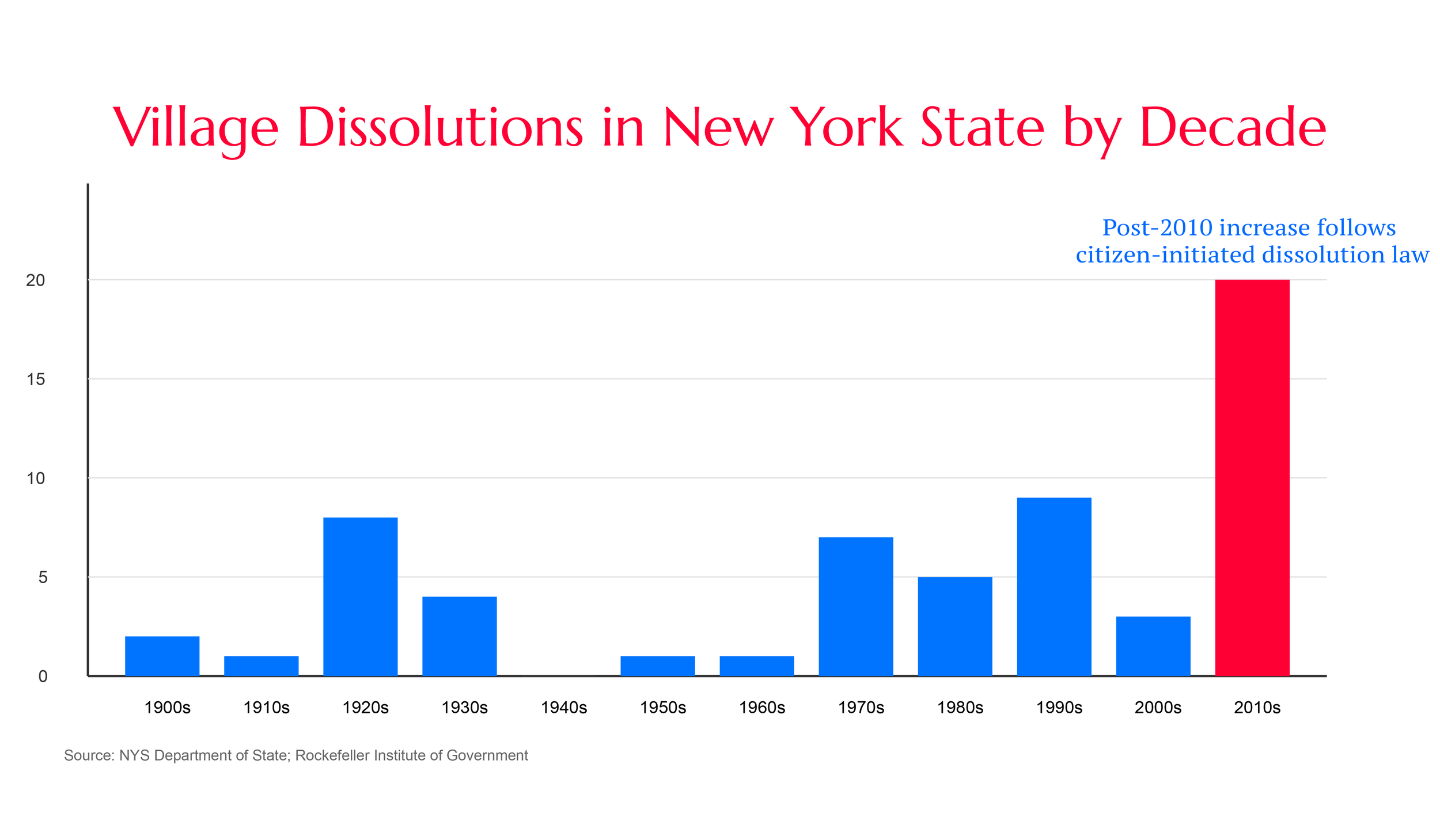
After the 2010 adoption of the Government Reorganization and Citizen Empowerment Act in New York, there was a noticeable uptick in village dissolution efforts—not because the state encouraged villages to disappear, but because it finally made it practical for communities to vote on the question themselves. Before the law, dissolution was legally possible but procedurally difficult, expensive, and dependent on village boards initiating a process that could eliminate their own positions. The 2010 law removed those barriers by giving residents a direct, voter-driven pathway, standardizing timelines, and pairing local choice with state planning support. As a result, more villages began conducting formal studies, holding referenda, and openly debating whether their existing structure still made sense. Some ultimately dissolved, others voted no, but across the state, the conversation itself became more common and more transparent. The increase reflected greater access and empowerment: communities were finally able to ask the question, review real data, and decide for themselves whether dissolution was the right fit.
-
The story behind the Act is basically this:
The structure felt outdated. Villages are “a municipality within a municipality.” Village residents already live in, pay taxes to, and vote in the surrounding town—then also fund a separate village government.
Property-tax pressure made duplication a target. State-level leaders increasingly framed overlapping layers as a driver of high local tax burdens and a barrier to efficiency.
Officials weren’t always eager to put dissolution on the ballot—so the law empowered voters. The Rockefeller brief is blunt: by easing citizen initiation, the Act was meant to let residents pursue reorganization even when elected officials were reluctant.
-
Before the Government Reorganization and Citizen Empowerment Act, decisions about village dissolution or consolidation were largely controlled by village boards themselves. In practice, this meant that even when residents had concerns about cost, efficiency, or transparency, it was often difficult to formally begin a dissolution conversation unless the very officials whose positions might be eliminated were willing to advance it. As a result, many communities never had the opportunity to fully study or vote on reorganization, even when public interest existed.
The Act changed that balance of power. It gave village residents a direct path to initiate dissolution or consolidation, either through a citizen petition or a referendum, and required that the final decision rest with voters, not just elected boards. It also standardized the process statewide, so residents in different parts of New York had the same basic rights, timelines, and protections when exploring reorganization.
Just as importantly, the Act reduced procedural barriers that made dissolution unnecessarily complex and encouraged communities to study reorganization without stigma. It paired local choice with state support, including planning grants, so residents could access real financial and service data before voting. In effect, the law didn’t push villages to dissolve—it ensured that villagers gained the right, tools, and authority to ask the question and decide for themselves, based on information rather than assumption.
-
A key point that gets lost in “dissolution = savings” slogans is that dissolution is not a single event—it’s a structured transfer of a living municipal system.
The dissolution plan is where “real life” is decided. Under Article 17-A, a dissolution plan must lay out, at minimum:
fiscal estimate of dissolution costs
transfer/elimination of employees
assets and liabilities/indebtedness
agreements with the town(s) to carry out dissolution
how residents will continue to receive municipal services afterward
terms for disposition of assets and liabilities, including taxes/assessments needed
whether village laws remain in effect after dissolution (typically up to two years unless stated otherwise)
effective date, hearings, and other necessary items
That list is important because it shows what dissolution really is: not “turning government off,” but reallocating responsibility, money, people, and rules. While every plan is local, dissolutions in NY commonly result in a few predictable outcomes:
The “village tax” ends, but some costs remain targeted to the former village.
Village government disappears, but its existing debts and certain service costs often don’t magically vanish. Many dissolutions use town special districts / special improvement districts to keep charging only the former village area for things that remain “village-specific” (like water/sewer systems, street lighting, sidewalks, or legacy debt). The pre-2010 DOS guide is explicit that dissolution plans must address outstanding obligations and the levy/collection of necessary taxes/assessments, and it provides real-world examples where special districts are created to fund particular services post-dissolution. (archive.cgr.org)Services continue—sometimes similarly, sometimes differently.
Article 17-A requires the plan to state how services will continue after dissolution.
In practice, towns may:absorb DPW functions, street work, snow/ice operations, parks, etc.,
keep water/sewer as a district function,
restructure code enforcement/zoning administration, and
renegotiate contracts for shared services.
Local laws may carry over temporarily—but governance shifts.
The dissolution plan must state whether village laws remain in effect after dissolution or for a specified period (often tied to the common “two-year” transition concept).
But the political shift is immediate: decisions that were once made by a village board are now made by the town board (or through districts/agreements). That’s a governance tradeoff—less duplication, but also less village-specific control.The administrative overhead is what most directly disappears.
The “cleanest” savings are often the ones tied to maintaining a stand-alone village administration: elected officials, clerk/treasurer functions, legal/audit duplication, elections, and related overhead. The Zhang paper summarizes the commonly asserted benefit: reduced administrative cost and lower village property tax burden (while noting the real-world complexity and tradeoffs).
It’s important to be honest: dissolution is not automatically positive for everyone. But across NY’s dissolution record, the commonly documented “wins” tend to fall into a few buckets.
Reduced duplication and clearer accountability
When “village inside town” structures dissolve, residents often experience simpler lines of responsibility: fewer boards, fewer budgets, fewer audits, fewer elections, fewer layers to call when something breaks. Rockefeller frames dissolution as a pathway many residents see as “modernization and lower taxes,” even as others fear it symbolizes decline.
Tax and cost rebalancing (often the core motivator)
The expected taxpayer benefit usually comes from:
eliminating village administrative overhead, and/or
restructuring service delivery (shared DPW, shared contracts, different staffing models).
State incentives and technical support strengthened the ecosystem
New York didn’t just change the law; it paired the policy direction with incentives and constraints:
Local Government Citizens Re-Organization Empowerment Grants (CREG) and the Citizen Empowerment Tax Credit (CETC) are available for villages whose voters are seeking dissolution, as well as for the towns absorbing the dissolved villages
Property values: evidence suggests “no big hit” inside dissolved villages
A notable empirical contribution comes from Pengju Zhang’s (draft) study of upstate NY dissolutions (2000–2014). In the models shown, dissolution does not significantly affect housing prices within former village areas
That finding matters for messaging: even if former village residents don’t experience a property-value penalty, community-wide politics can still be shaped by who believes they’re subsidizing whom.
Before the Act
Only village boards could initiate dissolution
Dissolution discussions were usually initiated by village boards
Procedures varied and were often legally complex
Studying dissolution was costly and difficult
Reorganization was often viewed as extreme or taboo
After the Act
Residents can initiate dissolution directly
Final authority rests with voters
A standardized, statewide process applies
State planning grants help fund studies
Studying options is normalized and encouraged
Many communities never reached a vote
Communities can study, debate, and decide openly
Learn More
Take a deep dive into the history of village dissolution in New York State
Official State Government Sources
Dissolve a Village – NY Department of State
An official page listing dissolved villages since 1900 and providing key reorganization resources from the Department of State. It includes links to guides and historical dissolution data.
The New N.Y. Government Reorganization and Citizen Empowerment Act – NY Department of State
The state’s own summary and description of the Act, explaining its purpose and procedures.
Government Reorganization – NY Department of State
A collection of state resources related to municipal reorganization, including citizen petition guides and legal frameworks.
The Citizen’s Guide to Petitioning for Local Government Consolidation or Dissolution - NY Department of State
A comprehensive citizen’s guide on how to petition, circulate signatures, and understand the statutory process.
Policy Research & Academic Analysis
Dissolving Village Government in New York State – Rockefeller Institute of Government (Parshall)
A well-regarded policy brief on the history, context, and impacts of village dissolution, including discussion of the Empowerment Act’s effects.
In Local Hands (discussion and podcast)
Rockefeller Institute podcast/interview with Lisa Parshall (author of the above report) about village dissolution trends in NY, pre- and post-Empowerment Act.
Outdated Municipal Structures – OSC/Local Government Handbook
Though broader than just dissolution, this type of publication helps explain the historical municipal structure context that informs why dissolution became a topic of policy interest.
New York State Law & Statutory Framework
New York State Senate – Consolidation & Dissolution Laws (searchable)
New York State Consolidation/Dissolution Legal Code
The statutory text of relevant state law (GML Article 17-A), which defines rights, thresholds, and processes for dissolution in New York.
Village Law – Article 19 (Village Dissolution)