

The Legal Timeline for Village Dissolution
Conversations about village dissolution often raise important questions— about timing, services, taxes, and what would actually happen step by step. Under New York State law, dissolution is not immediate, automatic, or informal. It follows a clearly defined, multi-stage legal process designed to ensure transparency, public input, and voter control at every phase.
No single action dissolves a village. A petition does not dissolve the Village. A vote does not immediately eliminate government operations. Even after voter approval, a detailed written transition plan is required, followed by public hearings and additional safeguards before any change takes effect.
This page outlines the full statutory process under New York General Municipal Law Article 17-A and explains what each step would look like specifically in Mount Morris. The timeline below is designed to provide clarity— not advocacy— so residents can understand the structure, safeguards, and realistic timeframes involved.
Understanding the process allows the community to evaluate options based on facts rather than assumptions.

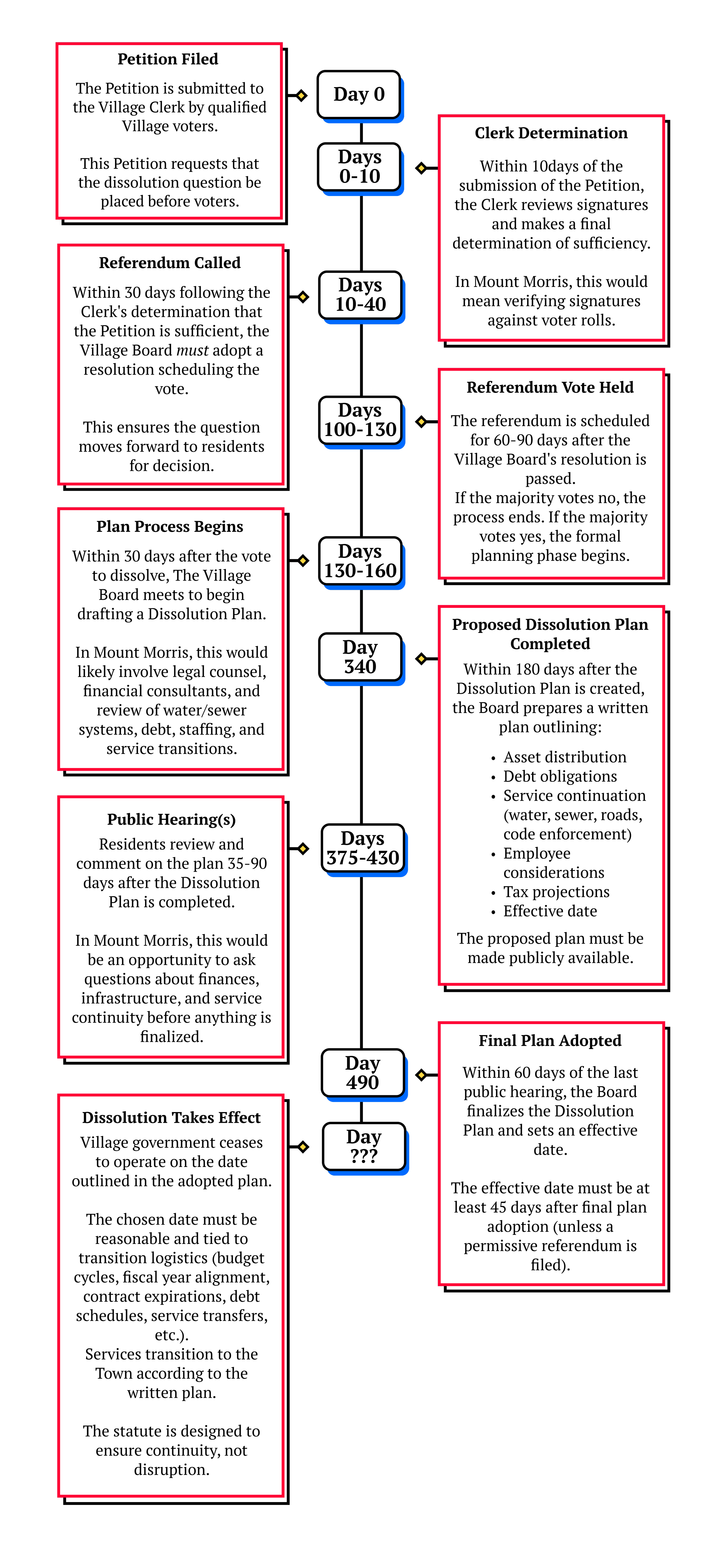
Estimated Timeframes
Absolute Minimum Total Timeline
From Petition Filing to Effective Dissolution:
Approximately 12–15 months
This assumes:
No procedural delays
Hearings scheduled at the earliest allowable dates
No permissive referendum on the final plan
Efficient administrative coordination
Even in the most streamlined scenario, the process unfolds over more than a year. Nothing changes immediately after a petition or even after a vote.
Maximum Practical Total Timeline
From Petition Filing to Effective Dissolution:
Approximately 16–20 months
This reflects:
Referendum held 60–90 days after resolution
Up to 180 days to prepare the proposed plan
Hearings 35–90 days after proposal
Up to 60 days to adopt the final plan
At least 45 days before the effective date
The statute intentionally builds in time for planning, transparency, and public input.
If this process were to move forward in Mount Morris, the Village Board would be responsible for preparing the Dissolution Plan and setting the effective date. That planning should prioritize fiscal responsibility, service continuity, and long-term sustainability for residents.
Because the Town would assume Village services under the adopted plan, coordination between Village and Town leadership would be essential to ensure stability and careful financial stewardship throughout the transition